

Government Receivables
Why Government Receivables Are Well-Suited for Factoring
From a factoring perspective, government receivables carry a unique advantage — the debtor is a government entity. Federal, state, county, and municipal agencies are among the strongest debtors a factor can underwrite. The risk of non-payment due to insolvency or financial distress is virtually nonexistent. What you're dealing with is not credit risk — it's timing risk.
This distinction matters because it directly impacts how a factoring facility is structured. When the debtor is financially strong and the certainty of payment is high, the overall risk profile of the transaction improves. This can result in more favorable advance rates and terms compared to receivables from less creditworthy commercial debtors.
Factoring allows you to capture the value of that government contract now — converting a reliable but slow-paying receivable into immediate working capital that you can deploy back into your business.
How Factoring Government Receivables Works
The process follows the same general framework as factoring any other receivable, but government invoicing often comes with additional documentation requirements and compliance considerations.
After completing the contracted work, you submit your invoice to the government agency along with any required documentation — which may include certified payroll records, compliance certificates, progress reports, or proof of delivery depending on the nature of the contract. You then submit that same invoice and supporting documentation to Hexagon.
We verify the receivable and advance 80–90% of the invoice value directly to your account, typically within 24 to 48 hours. When the government agency processes payment and remits the full invoice amount, we return the remaining balance to you minus a small factoring fee.
It's important to note that some government contracts contain assignment of claims provisions that govern whether and how receivables can be assigned to a third party. Federal contracts, for example, are subject to the Assignment of Claims Act, which permits assignment under certain conditions, including proper notice to the contracting officer and the surety, if applicable. Hexagon understands these requirements and ensures that every government receivable we factor is handled in full compliance with the applicable rules and regulations.
Types of Government Contracts We Work With
Government contracting spans a wide range of industries and service types, and Hexagon works with businesses across this spectrum. Common examples include:
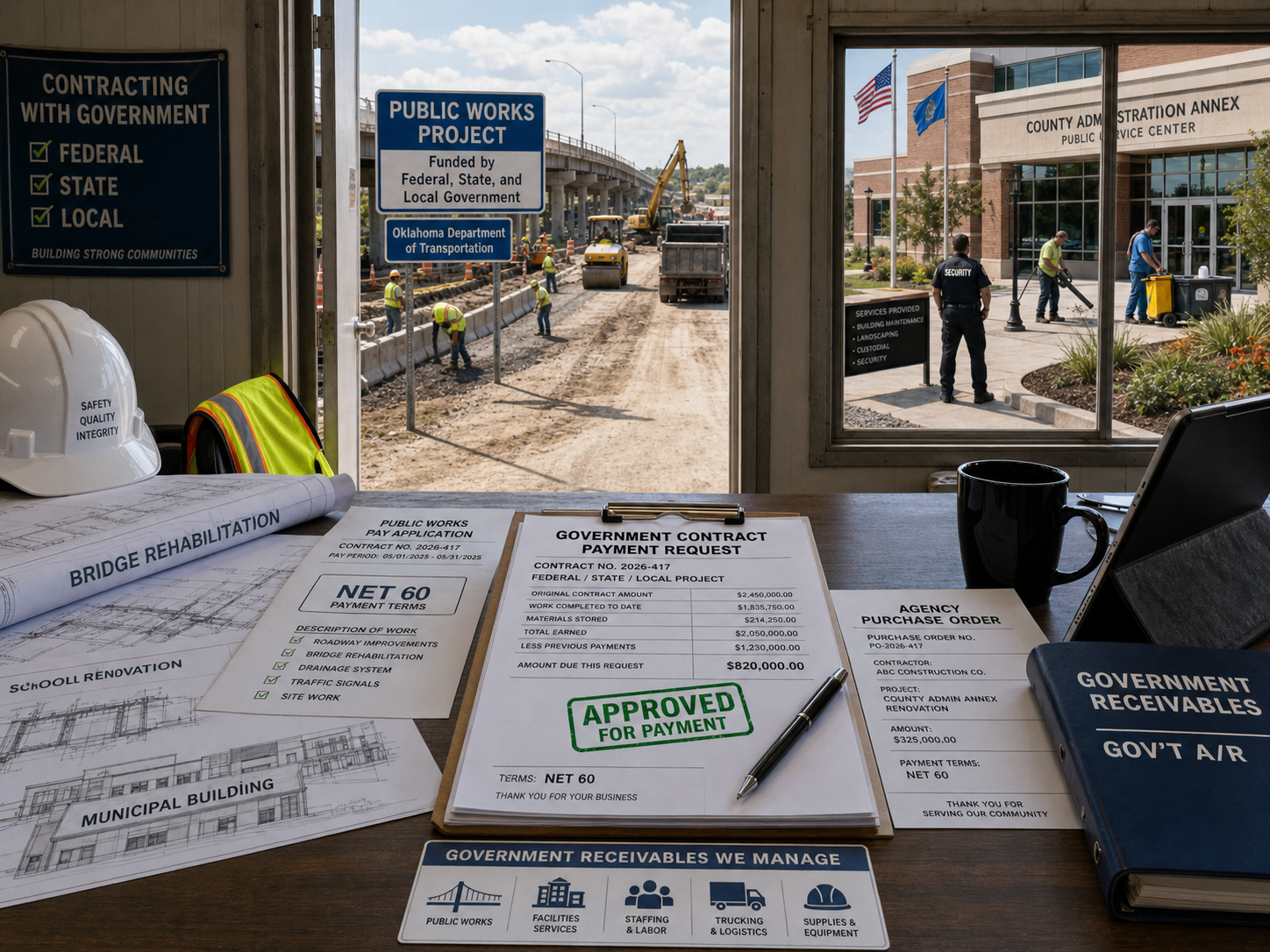
Construction and infrastructure subcontractors performing work on publicly funded projects such as roads, bridges, schools, and government buildings. Service providers holding contracts for facilities maintenance, janitorial services, security, landscaping, and IT support for government offices and installations. Staffing agencies providing temporary or contract personnel to government agencies. Trucking and logistics companies hauling materials, equipment, or supplies under government contracts. Manufacturers and suppliers fulfilling procurement orders for government agencies.
Regardless of the specific industry, the common thread is a creditworthy government debtor and a business that needs access to working capital faster than the government's payment cycle allows.
Navigating the Unique Aspects of Government Invoicing
Government contracts often come with a level of administrative complexity that commercial contracts do not. Invoices may need to be submitted through specific portals or systems. Payment may be contingent on inspection approvals, milestone certifications, or compliance verification. Budget cycles — particularly at the state and local level — can affect the timing and availability of funds, with fiscal year-end transitions sometimes creating temporary payment slowdowns.
Additionally, businesses working on publicly funded construction projects may be subject to prevailing wage requirements, certified payroll documentation, and bonding provisions that interact with the factoring process. Understanding how these elements work together is essential to structuring a factoring arrangement that functions smoothly within the government contracting environment.
Hexagon's banking background includes experience with government-related lending and the regulatory frameworks that govern public contracts. We understand the documentation standards, the compliance requirements, and the payment dynamics that are unique to government work — and we bring that knowledge to every government receivable we evaluate.
Why Government Contractors Work With Hexagon
Many factoring companies are willing to factor government receivables because the credit quality of the debtor is strong. But factoring a government invoice correctly — understanding the assignment requirements, the documentation standards, the compliance obligations, and the payment timing dynamics — requires more than just appetite for the deal. It requires expertise.
Hexagon brings decades of financial experience that includes direct involvement with government-related transactions. We know what questions to ask, what documentation to require, and what potential complications to watch for. We also understand that government contractors often work across multiple agencies and contract types simultaneously, which means your factoring facility needs to be flexible enough to accommodate that complexity.
Whether you hold a single local government contract or maintain an active portfolio of federal, state, and municipal work, Hexagon provides the knowledge, the capital, and the local presence to serve as a reliable financial partner for your government contracting business.